The Ultimate Guide To Orchid Care
Share
Orchid care comes down to four things: bright indirect light, watering only once the roots turn silvery and the mix is nearly dry, an airy bark-based potting mix instead of ordinary compost, and light monthly feeding through the growing season. Get those right and most orchids — including Phalaenopsis, Cambria, Oncidium, and Dendrobium — will reward you with blooms lasting months.
That's the short version. If you've killed an orchid before (most of us have — usually by overwatering, not underwatering, which surprises people), the rest of this guide covers exactly where things tend to go wrong, plus dedicated care notes for the most common orchid types: Phalaenopsis, Cambria, Oncidium, Dendrobium, Brassia, Paphiopedilum, Vanda, and Cattleya.
Orchid Care Basics: What Every Orchid Needs
Light
Orchids grow on tree branches in the wild, in dappled shade rather than open sun — which is why a plain windowsill in full midday glare tends to scorch them, while a dim corner leaves them refusing to flower. An east- or west-facing window, a few feet back from the glass, is usually the sweet spot. Dark, floppy leaves mean too little light; leaves with a reddish or yellow tinge mean too much.
Grower's tip: If you're not sure whether the light's right, check the leaf colour rather than guessing from the room. A healthy Phalaenopsis leaf is a soft mid-green — not the deep green of a shade plant, not yellow-green like it's stressed.
Watering
This is where most orchids actually die — not from neglect, but from kindness. Watering "little and often," the way you would a typical houseplant, keeps the roots permanently damp and starves them of oxygen. Most orchids want a thorough soak roughly once a week, followed by complete drying before the next one. The giveaway isn't the calendar, it's the roots: silvery-white means water now, green means wait.
Humidity and Airflow
UK homes, especially with central heating on, tend to sit at 30–40% humidity — orchids from tropical canopies want closer to 60%. A pebble tray under the pot, grouping plants together, or an occasional misting all help, but don't seal them into a stagnant, airless corner to compensate — good airflow prevents the fungal and bacterial problems that thrive in still, damp conditions.
Feeding
Feed at roughly half the strength stated on the label, every second or third watering, through spring and summer. Orchids are light feeders by nature, and a full-strength dose more often burns the roots than helps the plant. Ease off to once a month or less over winter, when growth slows.
Potting Mix and Repotting
Ordinary compost is the single most common orchid-killing mistake outside of overwatering — it holds far too much moisture around roots that evolved to hang in open air. A bark-based orchid mix lets air reach the roots the way it would on a tree branch. Repot every one to two years, ideally just after flowering finishes, into a pot only slightly larger than the last — orchids often flower better a little pot-bound than swimming in fresh space. Need Orchid repotting mix? Check out our orchid care range here.
Orchid Care by Type
The basics above get you most of the way, but each genus has its own quirks worth knowing.
Phalaenopsis (Moth Orchid) Care
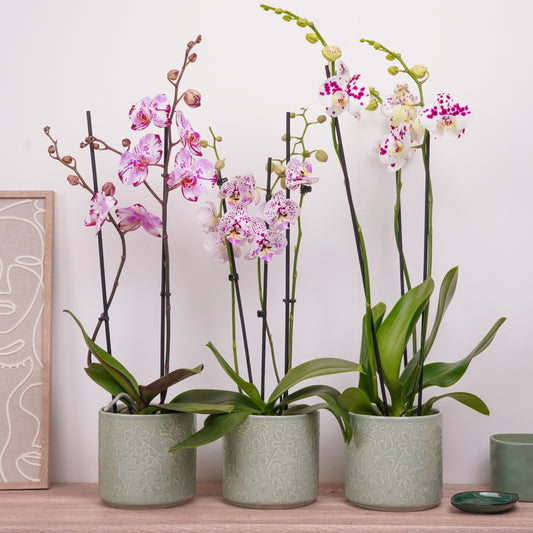
The moth orchid is the one most people picture, and for good reason — it's the most forgiving orchid you can buy, which is exactly why it's the one sold in every supermarket. Bright, indirect light and a weekly soak-and-drain routine suit it well; it tolerates the fairly stable temperatures of a normal living room (18–24°C) better than almost any other type. Blooms often last two to three months, and once they drop, cutting the spike just above a node frequently triggers a second flush rather than ending flowering for the season.
Grower's tip: Wrinkled leaves on a Phalaenopsis almost never mean it needs more water straight away — check the roots first. Damaged or rotted roots can't take up water even when you're watering correctly, so more water just makes it worse.
Cambria Orchid Care
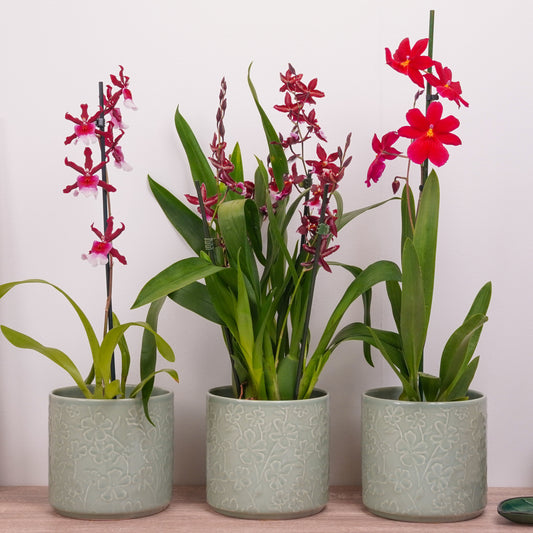
"Cambria" isn't a species but a trade name for a group of hybrids — usually crosses of Oncidium, Odontoglossum, and Miltonia — bred for bold, patterned flowers. They're tougher than the intricate blooms suggest. Keep the mix lightly moist rather than letting it dry out fully (Cambrias sulk more than a Phalaenopsis if left bone-dry), and give them slightly cooler conditions, 15–22°C, away from radiators. Yellowing pseudobulbs are usually a watering problem, not a feeding one — resist the urge to feed harder when a Cambria looks unhappy.
Oncidium Orchid Care
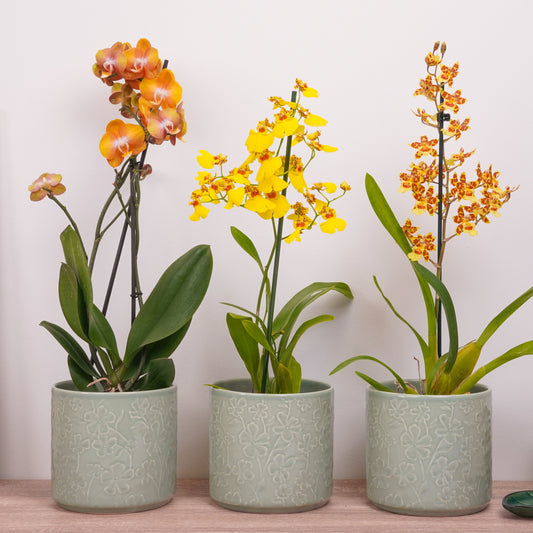
Known for branching sprays of small "dancing lady" flowers, often yellow or brown-marked, Oncidiums want more light than a Phalaenopsis — a south- or west-facing spot with some protection from the harshest midday sun. They're vigorous growers and drink more freely during active growth, but cut back hard once new growth matures. Shrivelled pseudobulbs are the plant telling you it went too dry during the growing season, not a sign to feed more.
Dendrobium Orchid Care
Dendrobium is a huge genus, but the types commonly sold as houseplants share one habit that trips people up: many need a genuine dry rest in winter — cooler temperatures and drastically reduced watering — to trigger flowering the following season. Skip that rest, and you'll get healthy leaves and no flowers, which is the single most common Dendrobium complaint.
Grower's tip: If your Dendrobium flowered beautifully once and never again, it's very rarely disease — it's almost always that it never got its winter rest. Move it somewhere cooler and cut watering right back from late autumn.
Brassia (Spider Orchid) Care
Brassias — spider orchids, for their long, narrow, spidery petals — are easier than they look once established, and several varieties carry a genuinely pleasant daytime fragrance, which is a nice surprise for anyone expecting a scentless houseplant. They want bright light similar to an Oncidium and regular watering through the growing season, drying slightly between. Fewer flower spikes than expected usually points to insufficient light rather than a feeding issue.
Paphiopedilum (Slipper Orchid) Care
The slipper orchid, named for its pouch-shaped lip, is one of the few orchids that's genuinely happy in lower light — a real option for a north- or east-facing room where a Phalaenopsis would struggle. Unlike most orchids on this list, it lacks water-storing pseudobulbs, so it shouldn't be allowed to dry out completely between waterings — keep the mix lightly and consistently moist instead. Watch for mushy, blackened leaf bases: that's crown rot from water pooling in the centre of the leaves, and it's avoidable simply by watering at the base rather than over the top.
Vanda Orchid Care
Vandas are the drama queens of the orchid world, often grown bare-root in slatted baskets with roots hanging freely in the air rather than buried in any mix at all. That exposed root system dries out fast — in warm weather, daily watering or misting isn't excessive, it's necessary. They want the brightest light and highest humidity (60–80%) of any orchid here; a steamy bathroom windowsill genuinely suits them better than a dry living room. Shrivelled, limp roots are a direct sign humidity or watering frequency has dropped too low.
Cattleya Orchid Care
The classic corsage orchid, grown for large, fragrant, ruffled blooms. Cattleyas want more light than a Phalaenopsis — leaves should look a light yellowish-green rather than deep green — and are one of the more drought-tolerant orchids here, preferring to dry out almost completely between thorough waterings. Failure to flower is nearly always a light problem rather than a feeding one, so if you're chasing blooms, a brighter spot solves it more often than a different fertiliser will.
Frequently Asked Questions
How often should I water my orchid?
Most orchids do best watered roughly once a week, with the mix allowed to dry out almost fully between waterings. Check the roots rather than following a fixed schedule — silvery-white roots mean it's time to water, green roots mean wait a few more days.
Why are my orchid's leaves turning yellow?
Occasional yellowing of older, lower leaves is normal ageing. Widespread yellowing across newer leaves usually means overwatering or too much direct light.
Can I use normal potting soil for orchids?
No — ordinary compost holds far more moisture than orchid roots can tolerate and is one of the most common causes of root rot. Use a bark-based orchid mix instead.
Why won't my orchid flower again?
Usually one of three things: not enough light, no seasonal temperature drop (important for Dendrobium and some Oncidiums), or over-feeding with a nitrogen-heavy fertiliser. Check light first — it's the most common culprit.
Final Thoughts
Every genus here has its own preferences, but they all fail the same way when the basics are wrong — usually too much water, not enough light, or compost instead of a proper orchid mix. Get the fundamentals right and even the trickier types, Vanda and Paphiopedilum included, become genuinely manageable.
Browse our full range of orchids and orchid care essentials — including specialist potting mix, feed, and pots — to give your plants everything they need to thrive.